Skill Building Series, Part 5: E-Commerce & Online Sales
E-commerce isn’t just for tech-savvy entrepreneurs with big budgets. It’s for anyone who wants to build something they control, from home, on their own timeline, without answering to a boss who doesn’t understand how their brain works.
For autistic and ADHD adults, e-commerce can be a surprisingly good fit. It combines creativity with structure. You can work at your own pace, in your preferred environment, while building something that grows over time.
And here’s the best part: you don’t need to reinvent the wheel. Platforms like Shopify, Etsy, and Amazon have already done the heavy lifting. You just need to show up and learn the system.
Why E-Commerce Works for Autism & ADHD
From my own experience, I can tell you that E-commerce isn’t “easy money.” Anyone who tells you that is selling something. But it is flexible. And flexibility matters when you’re navigating sensory overload, executive dysfunction, or social anxiety. Here’s what makes it work:
You control the environment. No fluorescent lights. No small talk. No open-plan office chaos.
You can hyperfocus. Product research, listing optimization, design tweaks—these are tasks that reward deep attention.
You can automate repetition. Once you’ve built a system, you can replicate it without having to start from scratch every time.
You can scale slowly. Start with one product. Add another when you’re ready. No pressure to go big before you’re stable.
E-commerce is at least less invasive than an office on your nervous system if you build it that way.
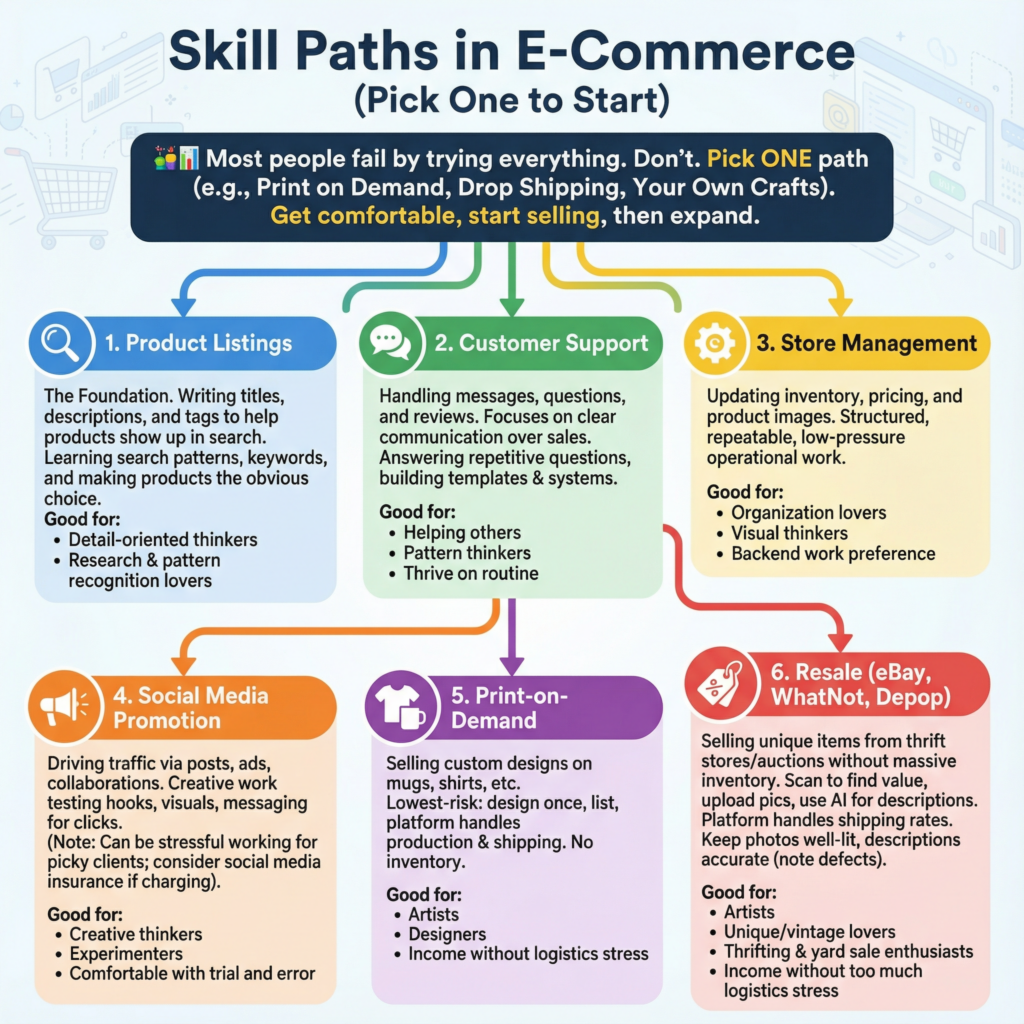
Skill Paths in E-Commerce (Pick One to Start)
Most people fail at e-commerce because they try to do everything at once. Don’t. Pick one skill path (Print on Demand, Drop Shipping, Your Own Crafts). Get comfortable, start selling, then expand.
1. Product Listings
This is the foundation. You’re writing titles, descriptions, and tags that help products show up in search. You’re learning how people search, what words they use, and how to make your product the obvious choice. Good for: detail-oriented thinkers, people who like research and pattern recognition.
2. Customer Support
Handling messages, questions, and reviews. This is less about “sales” and more about clear communication. You’re answering the same questions over and over, which means you can build templates and systems. Good for: people who like helping others, pattern thinkers, and those who thrive on routine.
3. Store Management
Updating inventory, pricing, and product images. This is operational work. It’s structured, repeatable, and low-pressure. Good for: people who like organization, visual thinkers, and those who prefer backend work over customer interaction.
4. Social Media Promotion
Driving traffic with posts, ads, or collaborations. This is creative work. You’re testing hooks, visuals, and messaging to see what gets people to click. Good for: creative thinkers, people who enjoy experimenting, and those comfortable with trial and error. Although from experience, this can be very stressful when working for other people. Other people can be very picky about what you post and how you post it. It is a good idea to have social media insurance to cover yourself if you intend to charge clients.
5. Print-on-Demand
Selling custom designs on mugs, shirts, and other products without holding inventory. This is the lowest-risk path. You design once, list it, and the platform handles production and shipping. Good for: artists, designers, people who want income without logistics stress.
6. Resale (eBay, WhatNot, Depop)
Selling mugs, shirts, and other products without holding massive inventory. Find one-offs and unique items at thrift stores and auction sites to resell. Take your phone, scan what you find interesting, and find the value instantly. You upload the pictures on the app, set the price, use AI to write the description, and the platform handles shipping rates. Package and mail on time, keep your photos well-lit and descriptions accurate, describe any defects, and wait for the sale. Good for: artists, people who love to find unique and vintage items, people who love thrifting and yard sales, and people who want income without too much logistics stress.
Tools to Get Started (Without too much overhead)
You don’t need to master every platform. Pick one. Learn it. Then decide whether to expand.
Ebay – Sell handmade, vintage, resale, or repurposed items.
Etsy – Best for beginners. Sell handmade items, printables, and digital goods. Built-in traffic. Lower barrier to entry.
Shopify – Build and customize your own online store. More control, but steeper learning curve.
Amazon Seller Central – Access the largest online marketplace. High competition, but massive reach.
Print-on-Demand Apps – Printify, Printful, Gelato. No inventory. No upfront costs. You design, they produce and ship.
I would say start with Etsy if you’re new. It’s the most forgiving. Open a store for $15. List each item for 20 cents and see what happens.
How to Learn Without Overwhelm
Here’s the truth: most people quit because they try to learn everything before they start. That’s backward. Here’s the sequence I used that did work:
1. Pick one platform. (Etsy is easiest for beginners.) I started on eBay, then expanded to Etsy, then moved to Shopify. I still sell on Etsy, eBay, and Shopify.
2. Learn the basics. How to list products. How to use keywords. How to add images. Check YouTube for tutorials, or Skool platforms, or Reddit. Or go to my stan-store
3. Start with small experiments. List 1–3 products instead of dozens. Focus on professional layouts and mockups. I use Photoroom on my iPhone, and it is fantastic, as well as placeit.com on my computer.
4. Study successful sellers. Look at their descriptions, photos, and pricing. Notice patterns. I have used Everbee to study listings and evaluate traffic.
5. Scale slowly. Find a niche. Once you see sales, expand your product line.
You’re not going to build a business over the weekend; it’s going to take time.
Where the Money Is
Ebay – Sell handmade, vintage, resale, or repurposed items. This is a really low-stress option; the platform is easy to navigate and post to, and you can sell items you source that same day from places like charity stores and resale shops. Sell stuff you no longer need in your house.
Etsy stores – Selling handmade, vintage, or digital products. Digital downloads (templates, planners, journals) are the lowest-stress option because there’s no shipping.
Shopify stores – Dropshipping, print-on-demand, or branded products. More control, but requires more setup.
Amazon FBA – Fulfillment by Amazon handles shipping and storage. You send inventory to their warehouse, and they handle the rest.
Digital downloads – Templates, planners, journals. No shipping. No inventory. Pure margin.
Digital products are the smartest entry point if you’re managing energy carefully.
Avoiding Pitfalls (Learn From My Mistakes)
I’ve seen people burn out fast in e-commerce – myself included. Customers can be really hard to please, packages arrive late or go missing, people forget they ordered from you, they don’t like their item, it doesn’t arrive as expected, or your supplier doesn’t ship on time. There are many pitfalls. Here’s how to avoid it.
1. Trying everything at once. Start with one platform. One niche. Get comfortable. Then expand. Focus on customer service, great products, and great designs.
2. Undervaluing your time. This is HUGE. Never race to the bottom on pricing. Charge what your work is worth, or the work won’t be worth it. If you can’t sell for a profit that replaces your current income, it isn’t worth selling. I see people make this mistake all the time. They underprice their items and end up selling for a loss. Calculate all costs, credit card fees, platform fees, shipping fees, including packaging, and business licenses and taxes.
3. Burnout from too much inventory. Use print-on-demand or digital products to reduce stress. E-commerce rewards patience, not frantic chaos.
4. Forgetting the business side of selling. Get a resale license, register your business, and remember to file taxes.
Free & Low-Cost Training Resources
You don’t need expensive courses. Start here:
- My Digital products and PDFs share everything I know. Visit my Stan-Store
- Etsy Seller Handbook (free)
- Shopify Compass Courses (free tutorials)
- Coursera: Introduction to Marketing (free audit)
- YouTube channels: Wholesale Ted, Oberlo, and other e-commerce educators
- Hubspot Academy and Certifications
- Ebay Sales
Learn as you go. Don’t wait until you “know enough.”
How to select your niche
Most people pick a niche based on what they like or what feels “aligned.” That’s how you end up with a store full of products nobody buys. Your niche needs to pass three tests before you commit a single hour to it.
✔️ Test 1: Is there existing demand? Don’t guess. Use Google Trends, Amazon Best Sellers, Etsy search volume, or TikTok hashtag views. If nobody’s searching for it, you’re probably in a desert. If you can find consistent searches in Google Trends or Amazon, you might be onto something. Think along these lines: People who like to fish are a niche, but then you can niche down further by saying “Fishermen who like deep-sea fishing, or “fishermen who like ice-fishing.” Or Nurses: Or the subniche “PICU Nurses.” If you have personal insight, that’s even better.
✔️ Test 2: Can you compete without a massive budget? If the top sellers have 50,000 reviews and professional photography, you’re not breaking in without serious capital. Look for niches where quality matters more than brand recognition, personalized gifts are incredibly good sellers (see AnywherePOD.com), niche hobbies (see the analogies above), and/or underserved subcultures.
✔️ Test 3: Does it solve a specific problem or trigger an emotional response? People don’t buy “nice designs.” They buy solutions to frustrations, gifts that say something meaningful or funny, or products that signal identity. If your niche doesn’t do one of those three things, it might not be scalable. Think adult t-shirts. Adults don’t really buy t-shirts from online stores, unless it resonates: Sarcasm and Star Wars. Moms with newborns. Moms and Child’s Sport. Dads and Nascar. Dad and child moments. etc. etc.
Pick a lane where demand already exists, competition is beatable, and buyers have a reason to care. Everything else is just expensive trial and error.
How and why you need to charge …
- Base Cost: Cost of the blank product + printing (from your POD provider).
- Shipping Cost: Cost to ship to the customer (often from the POD provider).
- Platform Fees: Listing fees, transaction fees (e.g., Etsy’s percentage of total sale, including shipping).
- Payment Processing Fees: Fees from payment gateways (e.g., PayPal, Stripe).
- Taxes: Sales tax collected and any taxes on your income/fees.
- Marketing: Ad spend, if any.
- Formula:
Selling Price = Total Costs ÷ (1 - Desired Profit Margin Percentage). - Example: If costs are $10 and you want 40% profit:
$10 ÷ (1 - 0.40) = $10 ÷ 0.60 = $16.67selling price.
- Formula:
Profit = Selling Price - Total Costs(after sale). - Net Profit: Your profit after all expenses are paid. A simpler way is:
Profit = Selling Price - (Base Cost + Shipping + Fees + Taxes).
- Online Calculators: Use free tools from Printful, Printify, or Etsy, which often have built-in fields for all these costs and can help find your price.
- Spreadsheets (Excel/Google Sheets): Create columns for each cost, then use formulas to find your total costs and profit per item
Final Thought
E-commerce gives you the chance to turn ideas into real income from a single Etsy listing to a full Shopify store. It’s not about overnight success. It’s about steady growth. With each listing you create and each skill you learn, you’re building a long-term business you control. That’s worth more than any paycheck.
👉 Next in the series: Part 6 – Data Entry & Online Research